On this page
In short
At Gamescom, NVIDIA said GeForce NOW members will soon get controls for DLSS Super Resolution, Dynamic Frame Generation and Ray Reconstruction. Two of the three are close to free in the cloud: Super Resolution buys the server frame rate, Ray Reconstruction cleans up ray-traced noise, and a cleaner picture also encodes better. The third is a trade. Frame generation raises the frames you see without making the game answer your controller any sooner, and in the cloud your controller is already at the end of a round trip. The menu is not live yet, so nothing here is a review of it: this is what the three settings do, and what changes when the graphics card is 500 kilometres away.
NVIDIA's Gamescom post gives the subject one sentence: new DLSS 4.5 controls will soon give members more choice over how supported games look and perform with DLSS Super Resolution, Dynamic Frame Generation and Ray Reconstruction. No date, no tier list, no screenshot. That is thin for a headline and it is still the most interesting thing announced for the service this year, because of what it implies. Until now the server decided how your game was rendered. Soon you will.
None of the three technologies is new, and the Ultimate plan has been running all of them for months: NVIDIA's own server upgrade page says Ultimate members already harness DLSS 4 Multi Frame Generation on the RTX 5080 machines. What is new is the dial: what each setting changes, what it costs, and which of the three behaves differently at the end of a wire than it does on a desk.
What NVIDIA announced for GeForce NOW at Gamescom 2026
One sentence about DLSS, and five other changes to the service. Half of it you can use tonight; half of it is a promise.
- GOG single sign-onLink the account once, sync the supported games in your GOG library, launch them in a click.
- FirefoxOfficially supported, alongside the browsers that already worked.
- Amazon Fire TV Stick 4K SelectThe app runs on it, with more Fire TV sticks to follow.
- The DLSS 4.5 controlsNVIDIA says soon, and gives no date, no tier list and no picture of the menu.
- Steam Machine and Steam ControllerLater in 2026, starting with Steam Deck and Steam Machines.
- Buying a membership through AmazonFire TV owners will pay inside their Amazon account instead of on nvidia.com.
Five games were named for the cloud on their release day: CONTROL Resonant, Gears of War: E-Day, Onimusha: Way of the Sword, The Blood of Dawnwalker and STAR WARS Zero Company. CONTROL Resonant also comes with a twelve-month Ultimate membership, which is the sort of bundle NVIDIA runs a few times a year. Our calendar tracks what is coming to each service, and the changelog records what actually arrived.
One thing to get straight before the rest, because a lot of the coverage has it the other way round. This is not frame generation arriving in the cloud. Frame generation has been running on the Ultimate plan since the RTX 5080 servers landed in September 2025, decided per game by NVIDIA. What arrives is your ability to turn it off.
DLSS Super Resolution: render smaller, then rebuild
The oldest of the three, and the one with almost nothing to weigh against it.
- What it does
- Renders the game at a lower resolution and reconstructs the full-size image with an AI model, using the previous frames and the motion between them.
- What it costs
- A little GPU time per frame, and far less than the pixels it saves. Some shimmer and ghosting in the hardest cases.
- What is new in 4.5
- A second-generation transformer model with five times the compute of the first, working in linear space rather than logarithmic. NVIDIA says Performance mode is now comparable to native, and can beat it.
Super Resolution is the setting people mean when they say DLSS. The game renders at, say, 1440p; the model rebuilds a 4K frame from it plus the frames before it. Because the render is cheaper, the frame rate goes up, and because the reconstruction is good, the picture usually does not go down. The modes are the amount of cheating: Quality renders closest to native, Ultra Performance renders furthest from it.
Nothing about that changes when the machine is in a data centre. There is one cloud-specific note: whatever the model produces is squeezed through a video encoder before it reaches you, so at 1080p on a laptop the gap between Quality and Balanced is often smaller than it looks in a desktop review.
If a control appears, Quality is the sane default. Performance is worth trying on a big screen, where the resolution you are asking the server for is high enough that even the cheap render has detail in it.
The clearest win of the three. It buys frame rate on the server without touching the input path, and the stream that reaches you is the same size either way. Leave it on.
DLSS Ray Reconstruction: one denoiser instead of many
Only matters in ray-traced and path-traced games, and in those it matters twice in the cloud.
- What it does
- Replaces the hand-tuned denoisers a ray-traced game uses to clean up reflections, shadows and lighting with a single AI model trained to do all of it.
- What it costs
- GPU time, and nothing else you would notice. It has no effect at all in a game with no ray tracing.
- What is new in 4.5
- A second-generation transformer released at Gamescom with 35% more compute and 20% more parameters than the model it replaces, at similar performance.
Ray tracing traces too few rays to be clean, so every ray-traced game ships denoisers that guess the rest. They are the reason reflections smear when the camera moves and lighting takes a moment to settle after a light turns on. Ray Reconstruction hands that job to one model, and it is the setting most likely to change what a path-traced game looks like on your screen.
There is a second effect that only shows up in streaming. Video encoders spend their bits on detail that changes between frames, and noise is detail that changes between frames. A noisy denoiser output does not just look noisy: it eats the bitrate that should have gone to the picture.
That is a general property of video compression rather than something NVIDIA has measured for GeForce NOW. It points the same way as everything else here.
Helps twice in a ray-traced game: the frame looks cleaner, and a cleaner frame is one the encoder can send at the same bitrate with fewer artefacts. Leave it on. In a game with no ray tracing it does nothing at all.
DLSS Frame Generation: frames the game never rendered
The one setting of the three that is a trade rather than a win, and the one to think about before you turn it on.
- What it does
- Generates whole frames between two rendered ones from motion vectors and an AI model. DLSS 4 generates up to three; DLSS 4.5 generates up to five.
- What it costs
- Latency, and some artefacts. The generated frames carry no new input, and the renderer has to hold a frame back to make them.
- What is new in 4.5
- Dynamic Multi Frame Generation: the multiplier moves on its own, aiming at the display's maximum refresh rate. NVIDIA calls it an automatic transmission for your GPU. RTX 50 only, in the NVIDIA app since 31 March 2026.
Here is the part that gets lost. Frame generation raises the number of frames on your screen. It does not raise the number of times the game reads your controller, and it cannot, because the extra frames are invented from two real ones that already exist. A game running at 30 fps with 4X frame generation shows you 120 frames a second and still answers you thirty times a second — and slightly slower than that, because the renderer must hold a finished frame back in order to interpolate towards it.
The cost is small and it is real. TechSpot measured about 10 ms of extra lag when frame generation went on in Cyberpunk 2077, with the second generated frame adding roughly 4 ms more and the third about 2 ms.
NVIDIA's answer is Reflex, which shortens the queue elsewhere in the pipeline and which it says lets DLSS 4.5 generate frames with minimal impact to responsiveness. On a desktop that is a fair summary. Tom's Hardware has been making the opposite point for two years: input latency is the missing piece of most frame-generation coverage, and NVIDIA's own claim that DLSS 4 raises frame rates without adding latency did not survive contact with the fine print.
The only one of the three that is a trade. It buys smoothness with latency, and in the cloud you are already spending latency on the round trip. The next section is about how much that changes the maths.
What the higher multipliers cost you
Higher multipliers are not free. PC Gamer's hands-on with the 5X and 6X modes found the frame rates real and the latency high for those frame rates, and the artefacts that DLSS 4 had in games like Alan Wake 2 still there in 4.5. Dynamic mode has a limitation NVIDIA states plainly: it is not compatible with frame rate limiters and V-Sync. Hold that thought for the next section.
Why frame generation behaves differently in the cloud
Two things change when the graphics card is in another city: what your input has to cross, and what a frame has to fit through.
- 1You press something
The frame that will show the result has not been rendered yet, and is not in the data centre yet either.
- 2Your line, outbound
The input travels to the nearest data centre. Our network test models that leg at roughly 8 ms plus 0.021 ms per kilometre, each way, and calls anything under 40 ms round trip comfortable.
- 3The game renders a frameSuper Resolution
Rendering below the output resolution and rebuilding it gets the server to the next frame sooner.
- 4The ray-traced effects are cleaned upRay Reconstruction
One model in place of several hand-tuned denoisers.
- 5Extra frames are generatedFrame Generation
The frames between two rendered ones. They are shown to you; they contain no answer to step 1.
- 6The frames are encoded
AV1 or H.265, up to 100 Mbps in Cinematic Quality, and capped at what the plan streams: 120 fps on Ultimate, 60 on Performance.
- 7Your line, inbound
The same leg again, carrying video this time instead of a key press.
- 8Your screen shows it
Everything above happened before you saw the result of the thing you pressed.
The first difference is arithmetic. On a desktop, frame generation adds its 10 ms to a chain that Reflex can hold near 30, so it is a third more. On GeForce NOW it adds the same 10 ms to a chain that already contains two crossings of your internet connection, and those crossings are the largest term in the sum for most people. Ten milliseconds on top of sixty is a smaller proportion and a worse place to spend it, because sixty was already near the edge of where a shooter stops feeling right.
The second difference is the ceiling. On a desktop the frames go to a monitor, and Dynamic Multi Frame Generation aims at that monitor's refresh rate. In the cloud they go to an encoder first, and your plan decides how many are allowed out: 120 a second on Ultimate, 60 on Performance. Generating more frames than the stream carries cannot reach you.
NVIDIA has said nothing about how the automatic multiplier reads a stream cap. The closest thing to an official answer is that Dynamic mode does not work with frame rate limiters on the desktop. That is a real question about a menu nobody outside NVIDIA has used, and we will update this page when it ships.
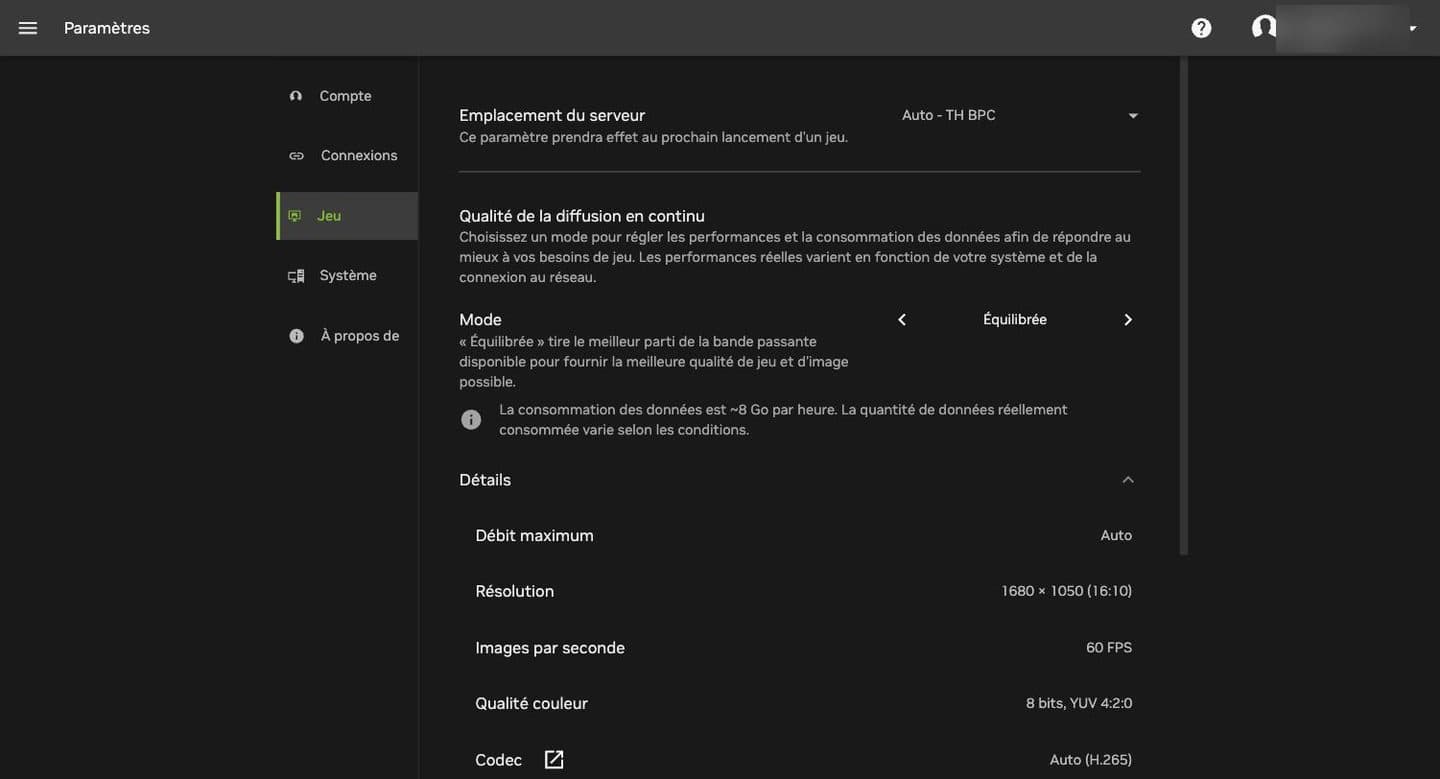
Nothing in this menu shortens the distance to the server. If your stream feels late today, the fix is a closer region or a wired connection, not a DLSS setting.
What to set when the controls arrive
Written against what the three technologies do, not against a menu we have used. We will revisit it when there is one.
A single-player game on a big screen
Everything on. Super Resolution on Quality, Ray Reconstruction on if the game is ray-traced, frame generation on. This is the case frame generation was built for: the smoothness is worth 10 ms in a game where nothing is shooting back.
Anything competitive
Frame generation off. You are already paying a round trip for every input, and generated frames add latency to buy smoothness you do not need in a game you play at 1080p. NVIDIA's own competitive mode goes the other way, dropping resolution to reach 360 fps — that is the shape of the trade in a shooter.
You are far from a data centre
Frame generation off, and then stop looking at this menu. At 80 ms or more the round trip dominates everything else on the page. Our servers map shows which region you are being sent to, and the network test estimates what your connection can do with it.
You are on Performance rather than Ultimate
Multi Frame Generation needs an RTX 50 GPU, and the Ultimate plan is the one NVIDIA describes as RTX 5080. NVIDIA has not said what the Performance tier gets, so treat Super Resolution and Ray Reconstruction as the settings that concern you until it does.
You are playing on a phone
Super Resolution on, and do not agonise over the mode. At that size, through that encoder, the picture settings matter far less than whether you are on 5 GHz Wi-Fi.
How DLSS 4.5 arrived
DLSS 4.5
- January 2026DLSS 4.5 announced at CES. The second-generation transformer for Super Resolution is available to try in the NVIDIA app; Dynamic Multi Frame Generation and the 6X mode are promised for spring (NVIDIA).
- March 2026Dynamic Multi Frame Generation ships in the NVIDIA app for RTX 50 cards, global or per game, aiming at your display's refresh rate — and not compatible with frame rate limiters or V-Sync (NVIDIA).
- August 2026DLSS 4.5 Ray Reconstruction is released at Gamescom, and NVIDIA says DLSS controls are coming to GeForce NOW. GOG single sign-on and Firefox support go live the same day (NVIDIA).
Sources
NVIDIA, read on 26 August 2026: the Gamescom 2026 announcements, DLSS 4.5 and its developer post, the NVIDIA app update that shipped Dynamic Multi Frame Generation, the CES 2026 post, the GeForce NOW server upgrade page and the GeForce NOW FAQ.
Testing and reporting: TechSpot on the latency frame generation adds, PC Gamer and Tom's Hardware hands-on with Dynamic Multi Frame Generation, Tom's Hardware on input latency in framegen coverage, and GamingOnLinux on the Steam Machine announcement.
The round-trip figures are our own model, the one behind the network test on this site. Nothing here measures the GeForce NOW controls themselves — they are not out yet.
Questions
Are the DLSS controls live on GeForce NOW?
No. NVIDIA said at Gamescom 2026 that they are coming soon, and gave no date, no list of which plans get them and no picture of the menu. GOG single sign-on and Firefox support did go live the same week.
Does frame generation make cloud gaming feel more responsive?
No, and it is the most common misreading of the feature. It raises the number of frames you see; the game still reads your controller at the rate it renders, and the generated frames add a few milliseconds on top. In the cloud those milliseconds sit on top of a network round trip you are already paying.
Does GeForce NOW already use DLSS?
Yes. NVIDIA's server upgrade page says Ultimate members already get DLSS 4 with Multi Frame Generation on the RTX 5080 machines, decided per game rather than by you. The Gamescom announcement is about handing that decision to members.
Will frame generation help me reach 120 fps on Ultimate?
On the server, yes, that is what it is for. Whether more generated frames reach your screen depends on what the stream carries, and Ultimate streams up to 120 fps. NVIDIA has not explained how the automatic multiplier behaves against a stream cap.
What is Dynamic Frame Generation?
The version of frame generation in DLSS 4.5 that chooses its own multiplier — between two and six generated frames per rendered one — aiming at the refresh rate of your display instead of sitting on a fixed setting. It needs an RTX 50 GPU and it shipped in the NVIDIA app in March 2026.
Will any of this shorten my queue?
No. A queue means your region has no free machine, which is a question of how many machines NVIDIA has and how many people want one. Our queue guide covers the three things that actually shorten it.
Every service, side by side, with live status and the plans as they stand today: compare the services.