
On this page
In short
GeForce NOW has the better picture, more servers and a free plan. Its Ultimate plan runs on RTX 5080 servers at up to 5K and 120 fps, and every region has a public queue you can check. Boosteroid has no hour cap and carries games that are not on GeForce NOW. For one month in the US, Ultra is $12.89, compared with $9.99 for GeForce NOW Performance and $19.99 for Ultimate. Annual offers are a separate commitment. Both stream the PC games you already own on Steam, Epic or another store. Three things decide it: which one carries your games, how far you are from its servers, and whether you play more than 100 hours a month.
Both services rent you a Windows machine in a data center and stream the games you already bought. Neither includes any games. GeForce NOW is NVIDIA’s service, on NVIDIA GPUs, with a free plan since 2020. Boosteroid is a smaller European service on AMD hardware, with no play-time cap. People who switch from one to the other usually do it for one of three reasons: the 100-hour cap, a game one of them does not carry, or the distance to the nearest server.
This guide compares them on the games, the price, the picture, the play-time limits, the servers, the devices, and what you can try for free. Prices and specifications are the operators’ own. Game counts come from our catalogue, which reads both services every day.
Boosteroid vs GeForce NOW: the specs side by side
The lines that differ between the two are the ones to read.
Three lines decide most cases: whether your games are on the service, the 100-hour cap, and where the nearest server is. The resolution figures matter on a television and much less on a laptop.
Games: the same stores, two different lists of what will run
Both open your Steam account. Neither runs all of it, and the gaps are different.
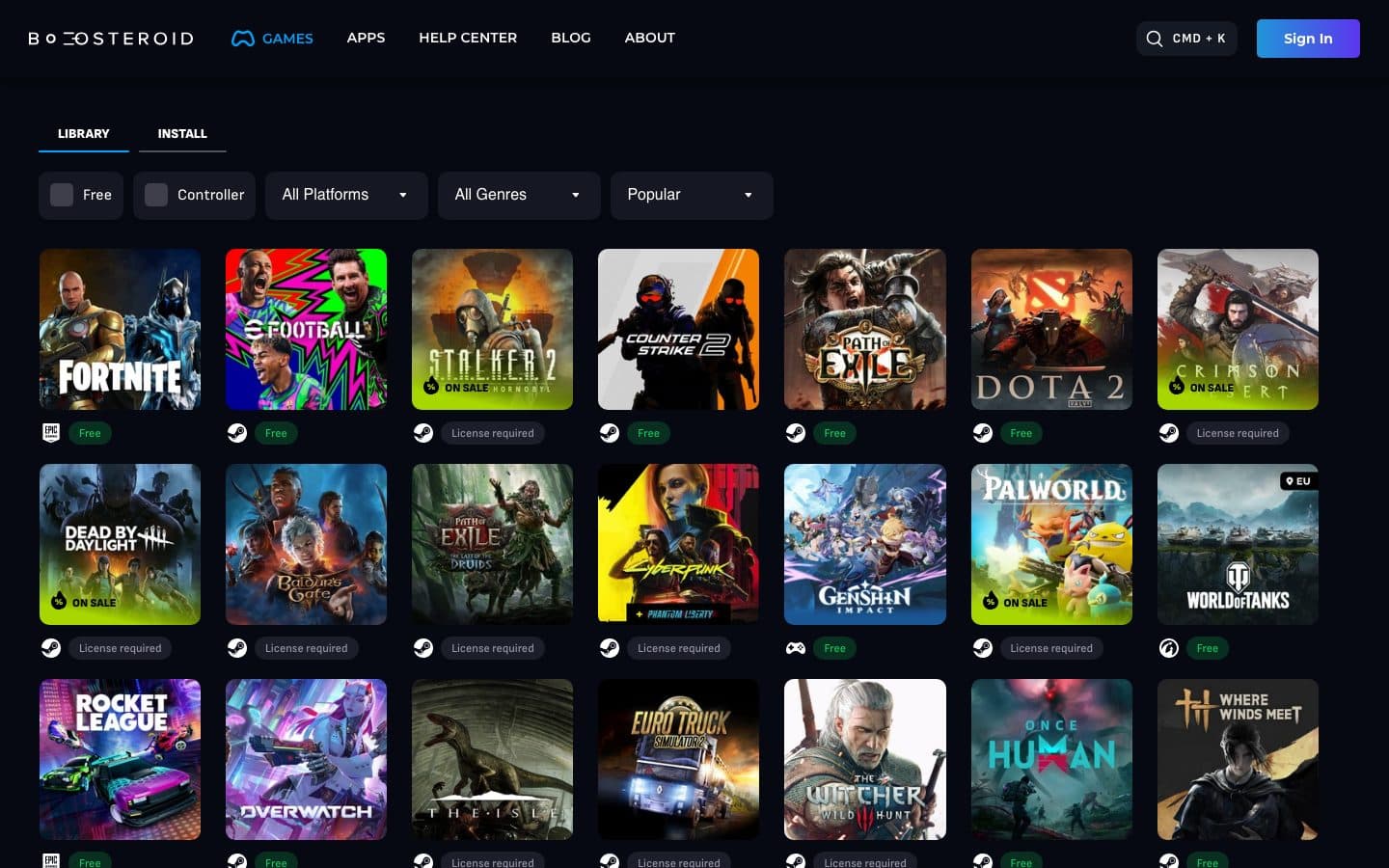
Both services work the same way. You link the stores you buy from, and the games you own appear in a library, minus the ones the publisher has not allowed. GeForce NOW links Steam, Epic, GOG, Ubisoft Connect, the EA app, Battle.net and PC Game Pass. Boosteroid links Steam, Epic, Ubisoft Connect, the EA app, Battle.net, Rockstar and PC Game Pass.
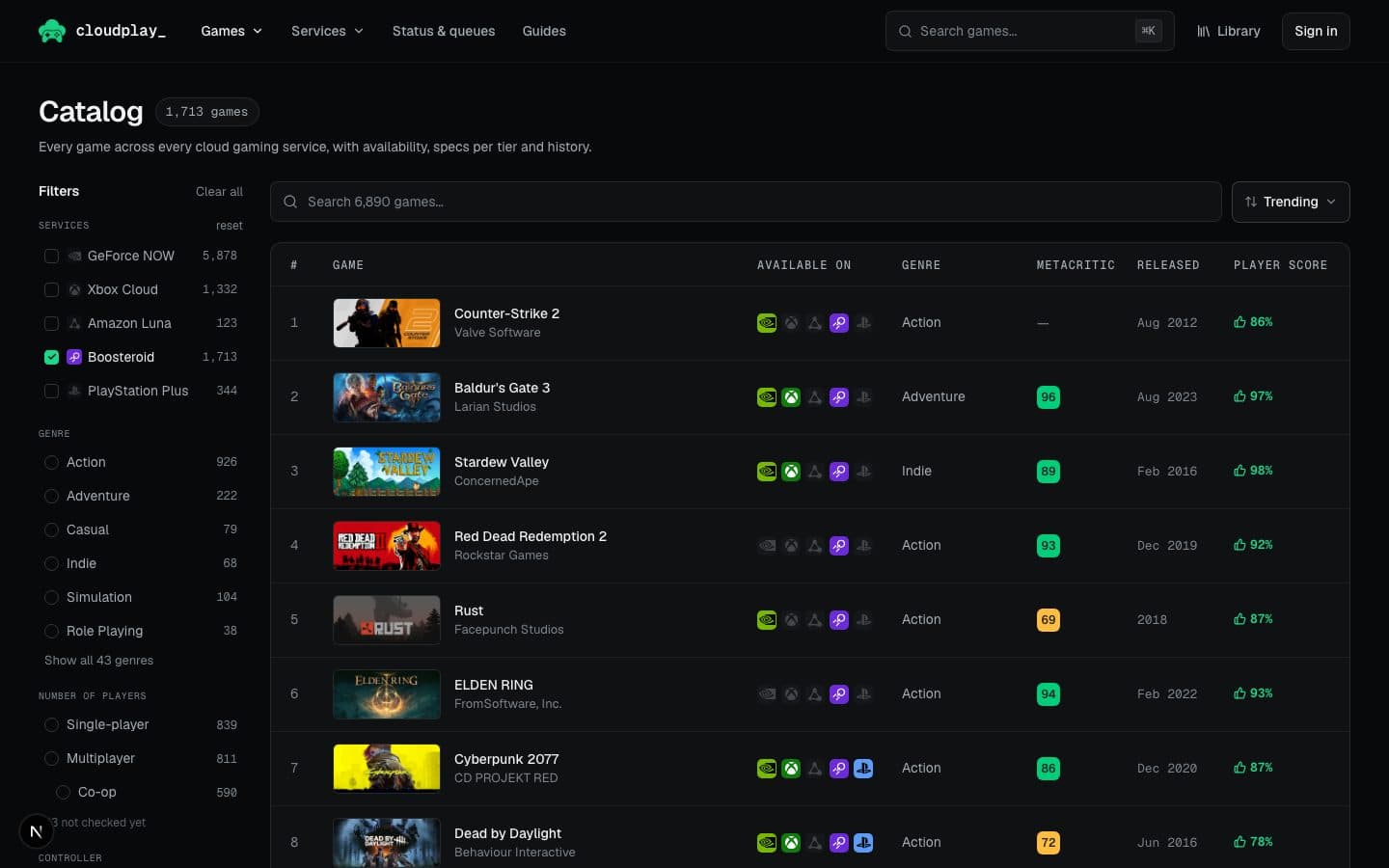
Today we list 6,068 games on GeForce NOW and 1,773 on Boosteroid. 1,100 are on both, and 673 are on Boosteroid and absent from GeForce NOW in our catalogue. Every publisher opts in to each service separately, and some that never signed with NVIDIA did sign with Boosteroid. The GeForce NOW list is about three times longer, so most of Steam’s long tail is there.
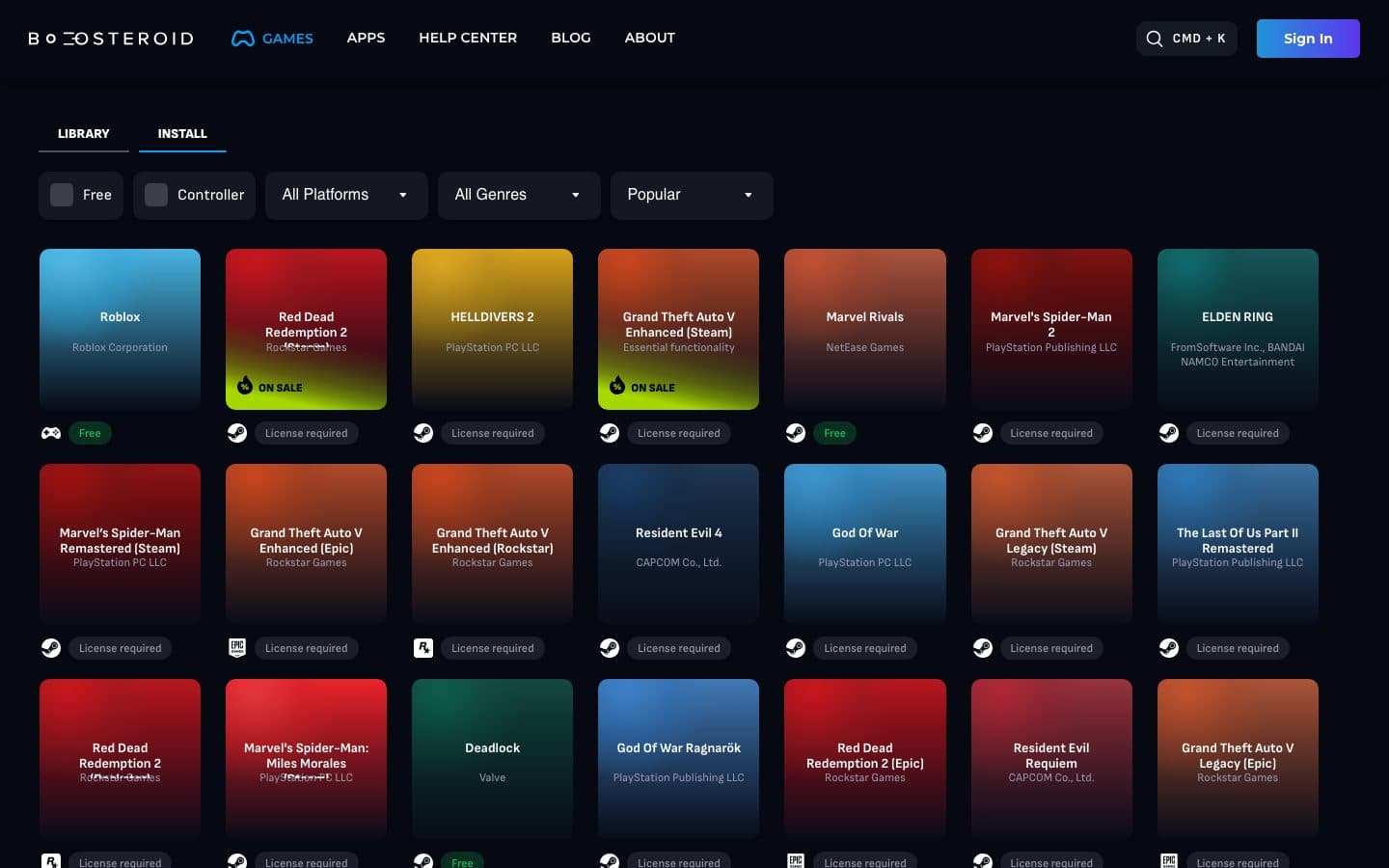
The games also start differently. About two thirds of the GeForce NOW list is Install-to-Play: the service installs the game when you launch it, which takes a few minutes and needs a paid plan. Boosteroid has two shelves: games already on its machines, and games you install once into your cloud storage, where they stay for the next session.
A game can leave either service
A publisher can pull a game from either service, and it leaves your cloud library the same day. Our changelog records each removal. On Boosteroid, a title in the catalogue still needs your own license on a store, and some games run only in some regions, marked with a flag in the library. Search a game before you subscribe, or paste your Steam profile to see which of your games each service streams.
Winner: it depends on you. GeForce NOW has three times the list. Boosteroid has 673 games GeForce NOW does not. Check your own library before anything else.
Games on Boosteroid but not GeForce NOW
We list 673 games on Boosteroid and not on GeForce NOW. This compares game listings in the catalogues we track, not worldwide exclusivity. Stores, editions and regional access can differ. Open a game to check the copy you need.
Boosteroid list updated · how we collect data
GeForce NOW list updated · how we collect data
20 of 673 listings shown, ordered by our catalogue’s trending score. Sources and methodology.
| Game | How it starts on Boosteroid |
|---|---|
| Transport Fever 3 | Ready to play |
| ACE COMBAT 8: WINGS OF THEVE | Install-to-Play |
| Risk of Rain 2 | Ready to play |
| DYNASTY WARRIORS 3 | Ready to play |
| Chained Together | Ready to play |
| Neon Abyss 2 | Ready to play |
| Torchlight: Infinite | Ready to play |
| Hello Kitty Island Adventure | Ready to play |
| The Binding of Isaac Rebirth | Ready to play |
| Geometry Dash | Ready to play |
| Limbus Company | Ready to play |
| HELLDIVERS 2 | Install-to-Play |
| Red Dead Redemption 2 | Install-to-Play |
| ELDEN RING | Install-to-Play |
| Football Manager 26 | Install-to-Play |
| ELDEN RING NIGHTREIGN | Install-to-Play |
| eFootball | Ready to play |
| Football Manager 2024 | Install-to-Play |
| Heartopia | Ready to play |
| NBA 2K26 | Install-to-Play |
A Boosteroid subscription is required. “Ready to play” describes the launch method, not an included game license.
Price: compare one month in US dollars
US monthly list prices, checked September 7, 2026. Annual offers and promotions are separate.
A high-end machine with ray tracing. Up to 4K at 120 fps. No limit on session time.
The same machine. A longer inactivity allowance, a choice of server location and more viewer seats for stream sharing. Sold for six months, or No monthly plan.
1080p at 60 fps. Sessions of 1 hour. You wait in a queue for a machine. Ads before the game starts.
1440p at 60 fps with ray tracing. Sessions of 6 hours. Priority access. 100 hours each month.
An RTX 5080 rig. Up to 5K at 120 fps, or 360 fps at 1080p. Sessions of 8 hours. 100 hours each month.
For US monthly billing, Boosteroid Ultra is $12.89 and Ultra Pro is $14.89. Both use the same hardware; Pro adds server selection, a longer idle allowance and more viewer seats. These are one-month prices checked September 7, 2026, not annual prices divided by twelve.
For the same US monthly billing period, GeForce NOW Performance is $9.99 and Ultimate is $19.99, checked September 7, 2026. Performance is the lower-priced monthly option here; Ultra costs $2.90 more. Annual plans require a longer commitment: compare the total charged today, renewal terms and your local currency before choosing.
The small print on paying
Check the checkout currency. Our US account showed dollars on September 7, 2026; other countries may see euros. Currency conversion, local billing and promotions can change what you pay. The service page shows prices by country. Do not compare an annual equivalent in one currency with a monthly price in another.
GeForce NOW bills in your currency, through NVIDIA or a partner. Outside North America, Europe, Japan and a few other markets it is sold by an Alliance partner with its own prices and plans. The $9.99 and $19.99 here are NVIDIA’s own. Both services bill in advance and neither refunds a partial month. Cancel before the renewal date.
Winner: GeForce NOW. Performance costs less for one month in the US. Boosteroid Ultra offers up to 4K at 120 fps for $2.90 more, with no monthly play-time cap.
Stream quality: RTX 5080 at 5K against AMD at 4K
Compare the resolution you need with the price of the plan that provides it.
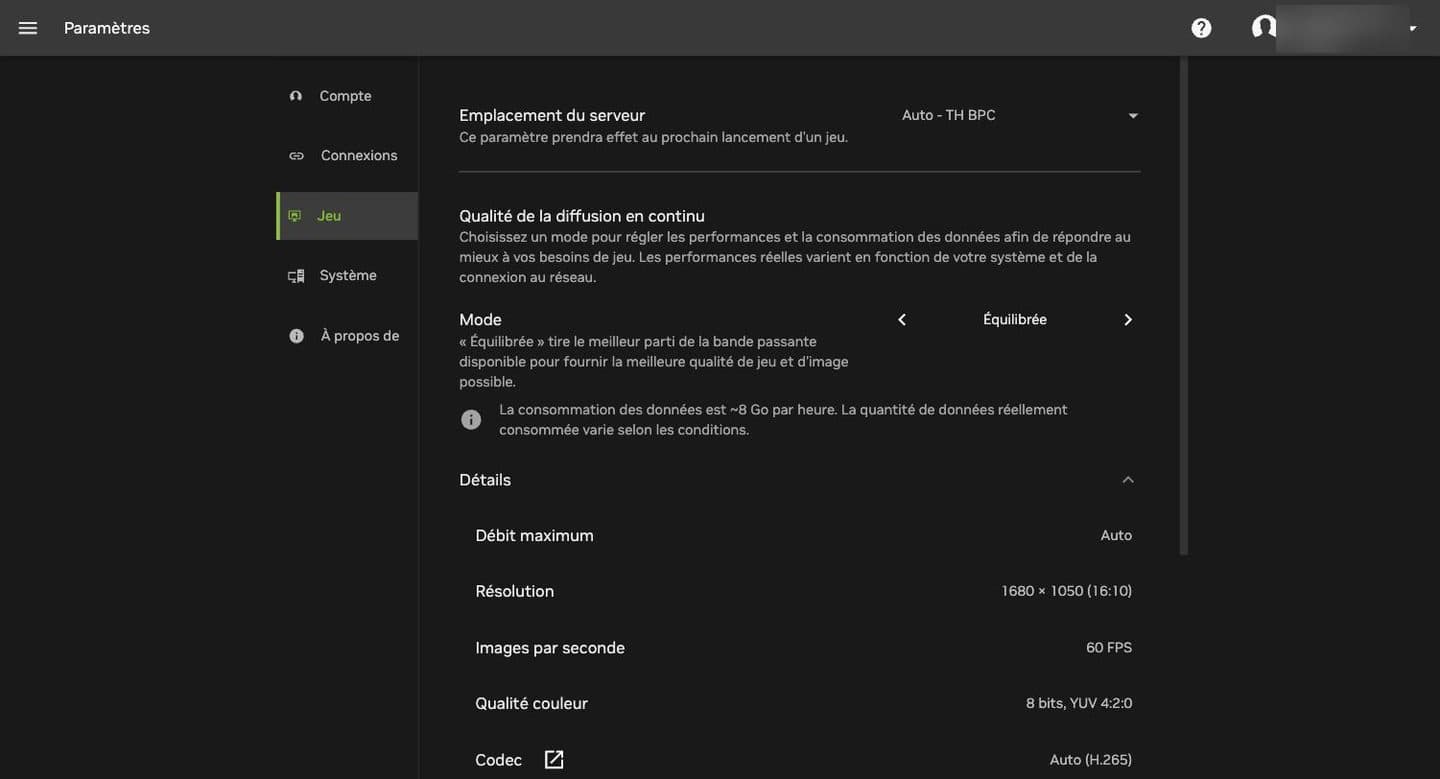
GeForce NOW Ultimate has run on RTX 5080 servers since September 2025: up to 5K HDR at 120 fps, 360 fps at 1080p in competitive mode, DLSS 4 and Reflex on supported games, and a Cinematic mode that streams 10-bit AV1 at 100 Mbps. Performance stops at 1440p and 60 fps, with ray tracing.
Boosteroid was a 1080p service until 2025, and many guides still say so. Since the Ultra plan, every member gets up to 4K at 120 fps on AMD hardware, with ray tracing, FSR and frame generation. Near a European data center, users describe a stream close to GeForce NOW Performance. One member in Frankfurt reports about 20 ms of latency. It is not the Ultimate tier.
“GFN Ultimate is better, but Boosteroid is 3x cheaper and no cap”
a former GeForce NOW member, on r/BoosteroidCommunity, 2026
Users who have tried both rank them the same way: better than GeForce NOW Performance, not as good as Ultimate. The complaints about Boosteroid are compression in dark scenes, a bitrate that drops when the server is busy, and a picture that changes with the server you are assigned. The complaint about GeForce NOW is the price of the plan that avoids all that.
What the top figures need
5K at 120 fps needs 65 Mbps and a monitor that can show it. 4K at 120 fps on Boosteroid needs a data center within a few hundred kilometers, which is rare in North America. On a laptop screen the two are much closer than the bars suggest.
NVIDIA names the card behind each plan and prints the resolution and frame rate each one reaches. Boosteroid says AMD, 4K, 120 fps, and no more: no card name, and no figure for what a busy evening does to your session.
What an hour costs your data cap
Neither service publishes what it sends per hour. Both publish the connection they recommend for each setting, and the table turns those into gigabytes per hour. A real session uses less, because the recommendation is a ceiling. On a 1 TB monthly cap, 4K every evening fits and 4K all day does not.
Boosteroid asks for more bandwidth at every setting: 35 Mbps for 1080p at 60 fps where NVIDIA asks 25, and 93 Mbps for 4K at 60 where NVIDIA’s 4K at 120 asks 45. Part of the difference is the codec, AV1 on GeForce NOW against H.264 and H.265 on Boosteroid.
Winner: GeForce NOW. Ultimate has more pixels, three times the frame-rate ceiling, DLSS 4 and HDR. At the $9.99 tier the gap is small.
Play-time limits: a 100-hour cap against no cap at all
The reason most people switch.
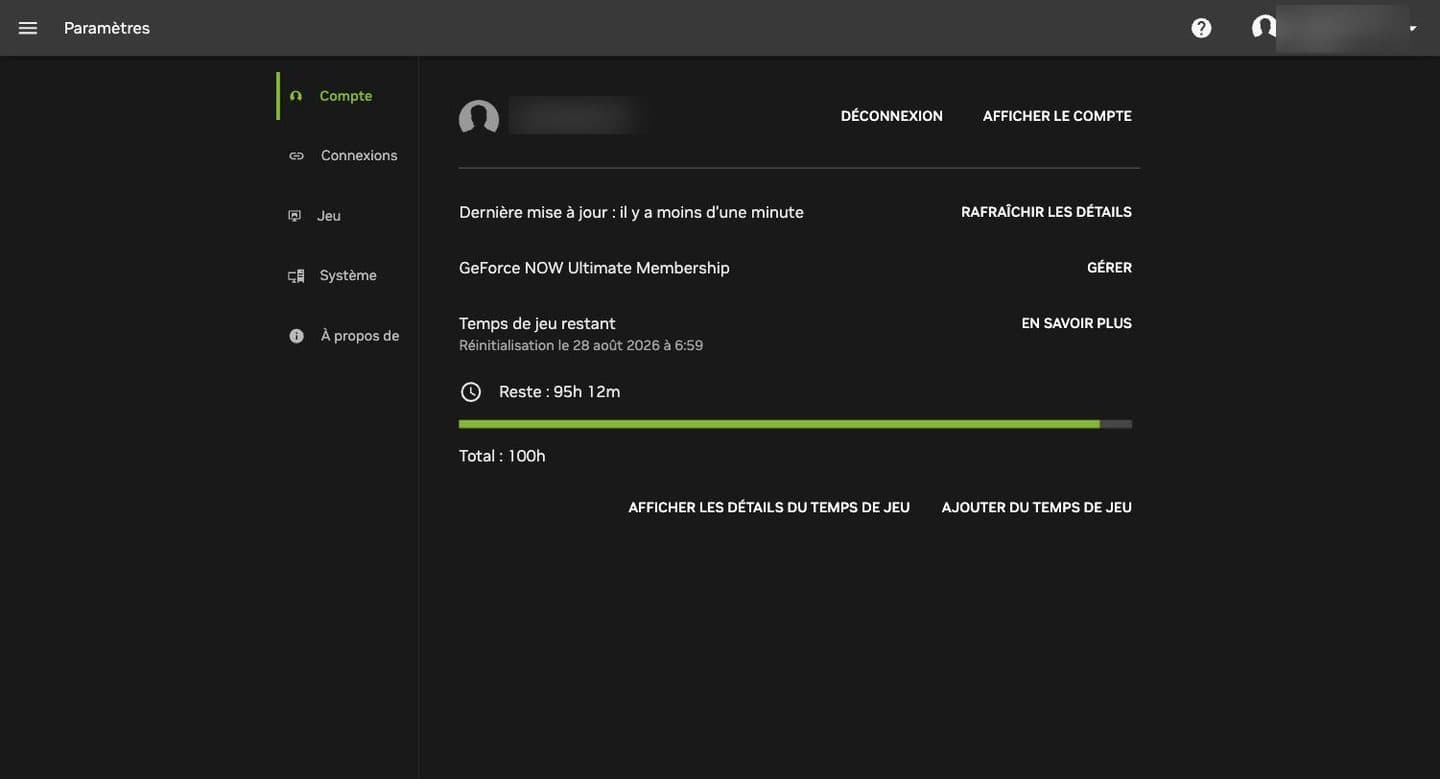
Since the first billing date after January 15, 2026, every paid GeForce NOW member gets 100 hours a month. Up to 15 unused hours roll over to the next month, once. When the hours run out you buy more in blocks of 15: $2.99 on Performance, $5.99 on Ultimate. Sessions still end at six hours on Performance and eight on Ultimate. Founders members, who joined before March 17, 2021 and never lapsed, keep unlimited hours unless they upgrade to Ultimate. Free members are not counted. NVIDIA says about 6% of members reach the cap.
An hours budget, worked out
Two hours on four weeknights and six hours on each weekend day is 68 hours a month, inside the cap. Three hours every evening is 90, still inside. Five hours a day is 150. On Ultimate that month costs $19.99 plus four blocks at $5.99, about $44. On Boosteroid Ultra with US monthly billing it costs $12.89, without additional hour charges. Count your evenings before you choose.
Boosteroid has no monthly cap and no session timer. It closes a session after 10 minutes without input on Ultra, 15 on Ultra Pro, with three minutes to rejoin. At peak hours in busy regions there can be a queue, and Boosteroid publishes no figure for it.
“with the limited 100 hours… it was getting too expensive”
a GeForce NOW member of four years, on r/GeForceNOW, December 2025
Winner: Boosteroid. No cap, no timer, nothing to buy at the end of the month.
Servers and latency: 36 regions with a public queue, against 29 without one
Latency is distance. Only one of the two shows you the distance before you pay.
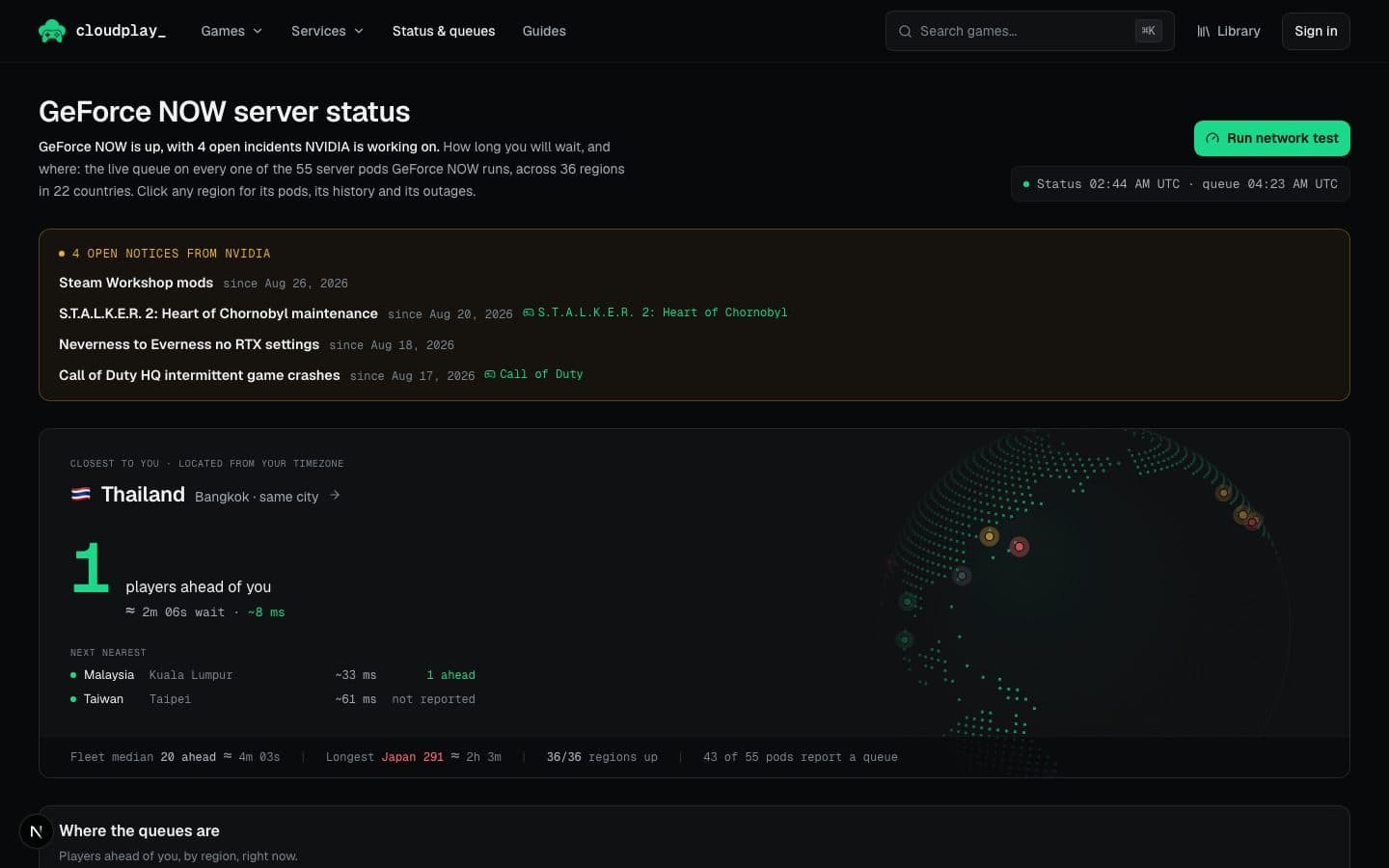
GeForce NOW runs about 36 regions: NVIDIA’s own in North America, Europe, Japan and India, and Alliance partners elsewhere with their own prices and plans. NVIDIA publishes the status of each region, and our servers page shows the queue at each one, so you can look at the region near you on a Friday evening before you pay.
Boosteroid had 29 data center locations in March 2026, across Europe, North America and Brazil. Most of them are in Europe. It publishes no map, no status page and no queue figure. Users in Frankfurt report a clean stream at about 20 ms. Users in the US report a soft picture and heavy input lag. Ultra Pro members can choose a server. Ultra members get the nearest one.
Our network test estimates latency from your location and samples download speed from Cloudplay. It does not contact gaming servers or report their live status.
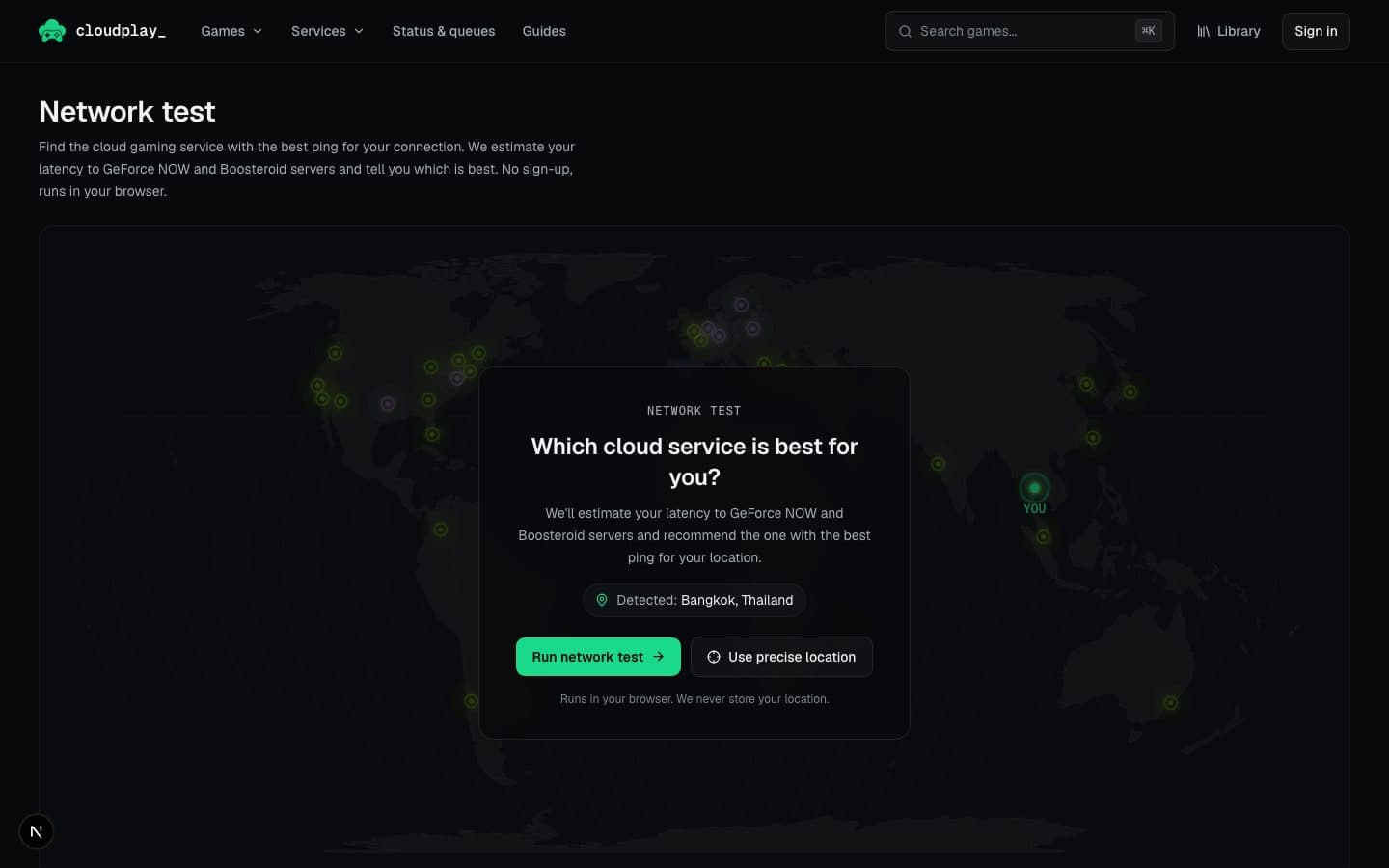
Winner: GeForce NOW. More regions, a status page, and a queue you can read before paying. In Germany or Poland the two are level. In Texas or São Paulo they are not.
Devices: two services that run almost everywhere
Mac, Linux, TVs and phones on both sides. The differences are the Steam Deck and the Shield.
GeForce NOW has native apps on Windows, macOS, Linux (out of beta since August 2026), ChromeOS, Android, NVIDIA Shield, LG and Samsung televisions, and a Steam Deck app that reaches 4K at 60 fps docked. On an iPhone or an iPad you use the browser.
Boosteroid has apps on Windows, macOS, Linux, Android, Android TV, LG, Samsung and, since January 2026, Whale TV sets. Everywhere else, iPhone included, it runs in a browser. There is no Steam Deck app: the Linux build does not install on SteamOS, so Deck owners use the browser or a community package.
Winner: GeForce NOW. Only for the Steam Deck and the Shield. On a Mac, a Linux desktop, a phone or a television the two are level.
Free plans and trials: what you can try before paying
GeForce NOW has a free membership. Boosteroid requires a paid subscription to play, even for free-to-play games.
GeForce NOW’s free plan needs no card and has no end date: 1080p at 60 fps, one-hour sessions, the standard queue and, since 2025, up to two minutes of ads while you wait. It is slow, and it is the best way to find out what cloud gaming is like on your connection, in your region, with your games.
Boosteroid has no free trial. A paid subscription is required even for free-to-play games. Without paying, you can browse the catalogue and run its connection test. Test the connection and consider a single month before committing to a year.
Winner: GeForce NOW. A free plan that runs your own games.
The verdict: is Boosteroid or GeForce NOW better for you?
It depends on your Steam library, your country and your hours.
Choose by your games, connection and hours first. On US monthly prices, GeForce NOW Performance costs $9.99, Boosteroid Ultra $12.89 and GeForce NOW Ultimate $19.99. Ultra offers up to 4K and no play-time cap; Ultimate offers up to 5K. GeForce NOW also has a free membership to test your connection before paying.
Take Boosteroid if
- You live in Europe, within a few hundred kilometers of one of its data centers.
- You play more than 100 hours a month, or in sessions longer than eight hours.
- A game you own is on Boosteroid and not on GeForce NOW. 673 of them are.
- You want 4K streaming without a monthly play-time cap.
- You play on a Mac, a Linux PC, a phone or a television.
Take GeForce NOW if
- You play on a 4K television or a fast monitor and want what an RTX 5080 gives.
- You live in North America, Japan, India or anywhere Boosteroid has few servers.
- You want to see the queue near you before you pay, and a status page when something breaks.
- You play on a Steam Deck or a Shield.
- You want to try cloud gaming with your own games, for free.
Our services page puts both next to the other four, with live status and the plans as they stand today.
What people who switched say
Six threads from November 2025 to August 2026, on r/GeForceNOW, r/BoosteroidCommunity and r/cloudygamer. The same five points come back every time.
The ranking. Nobody who has used both calls one of them better outright. The most upvoted comment in the most recent thread puts it in one line:
“Better than geforce now performance, worse than ultimate.”
the top comment under “Is Boosteroid really that bad?”, r/BoosteroidCommunity, August 2026
The server you get. Boosteroid picks the data center for you, and not always the nearest one. Ultra Pro is the plan that lets you choose. People in Germany, Poland and Czechia are happy with the stream. People further away describe evenings that differ from one to the next.
“much more reliant on you having close proximity to a datacenter”
the top comment under “GeForce now vs boosteroid”, r/GeForceNOW, December 2025
“so sometimes you connect quite far away”
a Boosteroid member, r/BoosteroidCommunity, February 2026
Updates and settings. A GeForce NOW machine keeps your games installed and patched between sessions. On Boosteroid a game may need an update or a fresh download when you come back to it, and some report that in-game settings do not survive the session. People who play one or two games do not notice. People who rotate through a library do.
“having to reinstall or update some games every single time is an annoyance”
a member who tried Boosteroid for a weekend, r/GeForceNOW, November 2025
“boosteroid doesnt even save game settings, not even sound or keybinds”
the same thread, r/GeForceNOW, November 2025
The picture in motion. The complaint that sends people back to Ultimate is what compression does to a dark scene or a fast turn. What keeps people on Boosteroid is the higher resolution and lack of a play-time cap. Performance costs less on US monthly billing but has a lower maximum resolution.
“Constant compression artifacts, muddy textures in darker scenes”
someone who went back to GeForce NOW Ultimate after Boosteroid Ultra, r/cloudygamer, August 2026
The small print. Game Pass titles on Boosteroid ask for a Microsoft sign-in at every launch. A session with no input closes after ten to fifteen minutes. There is no refund once a plan has been used. None of this applies on GeForce NOW.
The games people switch for
These are the games that come up most often as the reason someone switched. Each one links to its page, which shows the services that carry it today.
 HELLDIVERS 2the most-cited reason to add Boosteroid. A Sony port that is not on GeForce NOW
 The Last of Us Part ISony port, Boosteroid only among the two
 Ghost of TsushimaSony port, Boosteroid only among the two
 Marvel’s Spider-Man 2Sony port, Boosteroid only among the two
 God of War RagnarökSony port, Boosteroid only among the two
 Grand Theft Auto Vnot on GeForce NOW since 2019. Boosteroid streams the Steam copy
 Red Dead Redemption 2same as GTA V
 Marvel Rivalsthe ranked shooter people test both on. GeForce NOW, at 120 fps on Ultimate
 Path of Exile 2GeForce NOW. Users in Germany report stutter on Boosteroid at busy hours
 Europa Universalis VGeForce NOW. The game that made strategy players compare the two in April 2026
 Monster Hunter WildsGeForce NOW, where the RTX 5080 tier makes the difference
 Tom Clancy’s The Division 2GeForce NOW. Ubisoft’s launcher is barely present on Boosteroid
Using both: one for the games, one for the hours
Cheap enough together that some people do.
Both stream the games you own, so nothing stops you from having both. Your Steam library appears in each, and cloud saves follow you wherever the game syncs them. The usual combination is GeForce NOW Ultimate for the games worth 5K on a television, and Boosteroid for long evenings and the games NVIDIA does not carry. With US monthly billing, Ultra and Ultimate together cost $32.88 a month. Cancel before renewal if you no longer need both.
What changed in the past twelve months
The updates that changed each service, in order.
Boosteroid
- September 2025Ultra Pro plan, €14.89, with a choice of server and a longer idle allowance (Boosteroid).
- January 2026Monthly Ultra goes from €9.89 to €12.89; the yearly €7.49 stays (Boosteroid). Apps on Whale TV sets (Boosteroid).
- March 2026New capacity in France, Poland and the Czech Republic; 29 locations in all (Boosteroid).
- September 2026Monthly Ultra goes from €12.89 to €16.89; the yearly €7.49 stays. Ultra Pro is sold for six or twelve months only (Boosteroid).
GeForce NOW
- September 2025RTX 5080 servers, 5K at 120 fps, Install-to-Play (NVIDIA).
- January 2026The 100-hour monthly cap applies to every paid member (AlternativeTo).
- April 2026Game Pass and Ubisoft+ labels in the app (NVIDIA).
- July 2026Public launch in India with local prices. A new server in Canada.
- August 2026The native Linux app leaves beta (NVIDIA).
Sources
Operator pages, read on August 28, 2026: Boosteroid, its pricing update, Ultra FAQ, help center and capacity announcement; GeForce NOW, the GeForce NOW FAQ and membership page, NVIDIA’s Blackwell announcement, the system requirements and the November 2024 post that priced the extra-hour blocks; Boosteroid’s terms, connection requirements and refund page.
User reports: the r/BoosteroidCommunity, r/cloudgaming and r/GeForceNOW threads linked where they are quoted, from 2025 and 2026, and BestGaming.cloud on Boosteroid in North America. Game counts and the overlap are our own, read daily from both catalogues.
Questions
Is Boosteroid better than GeForce NOW?
It depends on your games and connection. With US monthly billing, Boosteroid Ultra is $12.89 for up to 4K at 120 fps with no play-time cap; GeForce NOW Performance is $9.99 for up to 1440p with a 100-hour monthly cap. Ultimate is $19.99 and reaches up to 5K. Compare the same billing period and country, then check which service carries your games.
Can I play the same games on both?
We list 1,100 games on both services, but the supported store and edition must match your copy on each. Saves follow you where the game syncs them to Steam Cloud or a publisher account.
Which games are on Boosteroid but not GeForce NOW?
673 today. Publishers opt in to each service separately, and some signed with Boosteroid and not with NVIDIA. The selection above links to individual game pages with access conditions. This is catalogue absence, not worldwide exclusivity.
Does Boosteroid have a 100-hour cap?
No. Boosteroid has no monthly cap and no session timer. It closes a session after 10 minutes without input, 15 on Ultra Pro. GeForce NOW’s paid plans stop at 100 hours a month, with up to 15 unused hours carried over and extra blocks of 15 hours at $2.99 on Performance and $5.99 on Ultimate.
Does Boosteroid have a free trial?
Boosteroid has no free trial. A paid subscription is required even for free-to-play games. Without paying, you can browse the catalogue and run its connection test. Test the connection and consider a single month before committing to a year.
Which one has better latency?
The one with a server nearer you. GeForce NOW has about 36 regions and publishes their status. Boosteroid has 29 locations, mostly in Europe, and publishes nothing. In Germany or Poland users report about 20 ms on both. In the US, GeForce NOW is the safer bet. The network test estimates latency from your location; use each provider’s test to measure actual performance.
Does Boosteroid work on a Steam Deck?
Through the browser or a community package. There is no Boosteroid app for SteamOS. GeForce NOW has a native Steam Deck app that reaches 4K at 60 fps docked.
How much data does each one use per hour?
Based on the operators’ recommended connections, about 11 GB an hour for 1080p at 60 fps on GeForce NOW and 16 GB on Boosteroid, and about 20 GB for 4K at 120 on GeForce NOW and 42 GB for 4K at 60 on Boosteroid. A real hour uses less. On a 1 TB cap, 4K every evening fits and 4K all day does not.
Can I keep both?
Yes, and some people do: GeForce NOW Ultimate for the games worth its picture, Boosteroid for long evenings and the games NVIDIA does not carry. Your Steam library appears in both, and either subscription can be dropped in a month.
Every service, side by side, with live status and the plans as they stand today: compare the services.


